



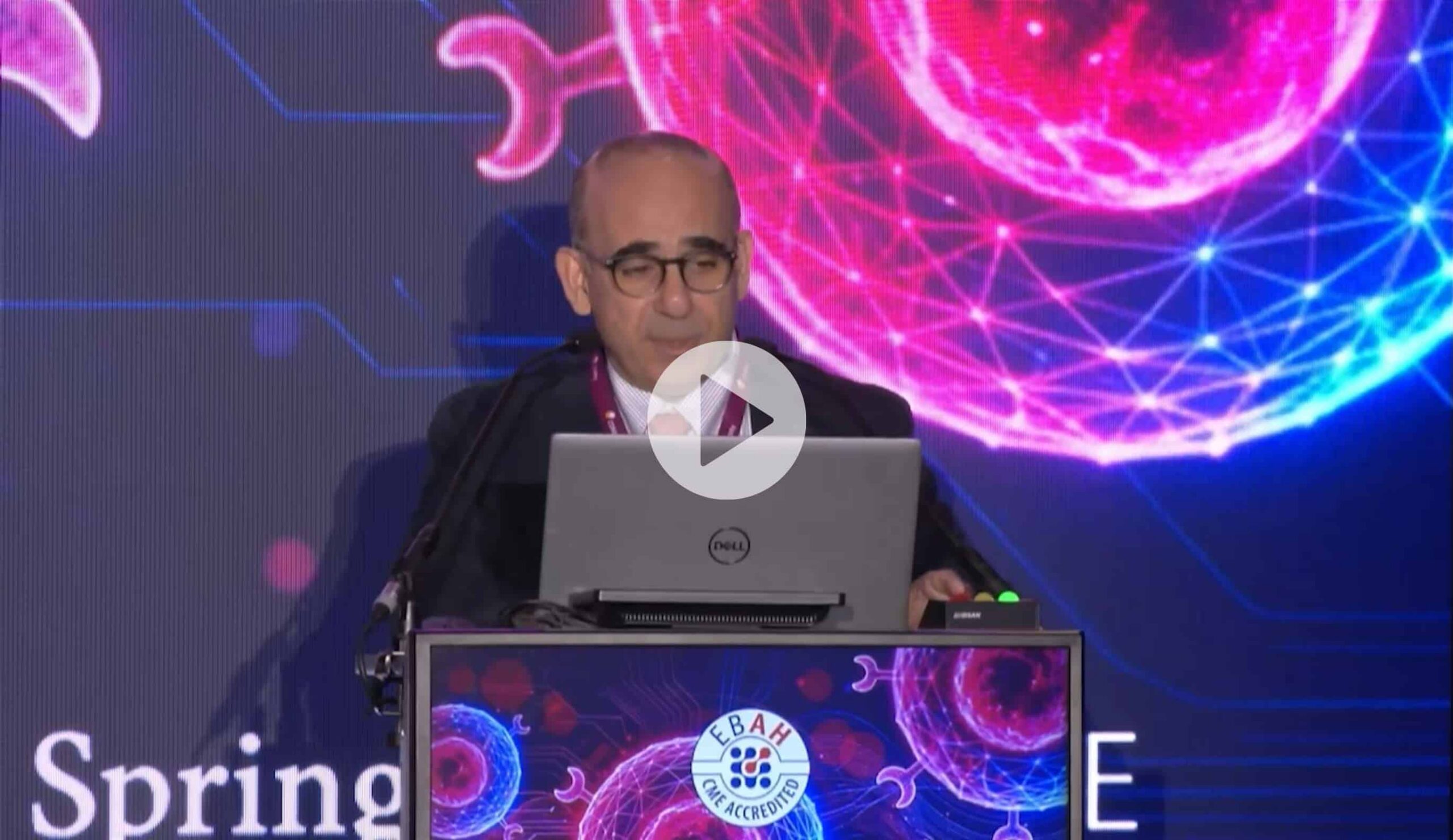
This COMy 2026 independent medical education symposium brought together an expert international faculty for an engaging and forward-looking discussion on how BCMA-directed therapies could reshape the frontline treatment paradigm in newly diagnosed multiple myeloma (NDMM). Professor Mohamad Mohty (France) chaired the session alongside an expert international faculty including Professors María-Victoria Mateos (Spain), Florent Malard (France), Evangelos Terpos (Greece), and specialist nurse Wendy Bursey (Canada).
Despite significant advances in NDMM, key challenges remain, from optimizing risk and frailty assessment to overcoming relapse and treatment burden. This symposium critically examined the biological rationale and emerging clinical evidence supporting earlier use of BCMA-targeted therapies, including bispecific antibodies, CAR-T, and ADCs, and what this could mean for future treatment strategies.
Through interactive polling, real-world insights, and a multidisciplinary panel discussion, the faculty explored whether we are approaching a “BCMA-first” era, and what practical, clinical, and system-level considerations must be addressed to make this a reality. Watch the on-demand recording to revisit the discussion, challenge current thinking, and explore how the future of frontline myeloma care may evolve.

| AGENDA | |
|---|---|
| 08:00-08:05 | Welcome Mohamad Mohty, France |
| 08:05-08:20 |
Current landscape in newly diagnosed multiple myeloma (NDMM)
María-Victoria Mateos, Spain |
| 08:20-08:35 |
Understanding the rationale behind BCMA-targeting in NDMM
Florent Malard, France |
| 08:35-08:50 | Emerging clinical data: BCMA-directed therapies in early disease settings Evangelos Terpos, Greece |
| 08:50-09:10 | BCMA early use: Opportunities and challenges Nurse specialist experience with BCMA-directed therapies in relapsed/refractory MM Wendy Bursey, Canada Panel discussion and Q&A All |
| 09:10-09:15 | Summary and close Mohamad Mohty, France |
This educational activity is supported by an independent medical education grant from GSK.
